

Traditional carbonara relies on the creamy emulsion of eggs and cheese, eliminating the need for cream. The key lies in timing: stirring vigorously as the residual heat transforms the sauce into a glossy coating for the pasta. This technique-driven dish highlights simplicity and skill.
| What cream usually does | What carbonara uses instead | Why it works |
|---|---|---|
| Thickens the sauce | Egg yolk | Yolk proteins begin to set below about 70 °C (158 °F), so they bind the sauce just short of scrambling |
| Adds richness | Rendered guanciale or pancetta fat | The fat left in the pan coats every strand and carries the flavour cream would otherwise mask |
| Adds salt and body | Pecorino Romano | A hard sheep’s-milk cheese that melts into the yolk and seasons the dish at the same time |
| Loosens the sauce | Starchy pasta cooking water | Dissolved starch emulsifies the fat and the yolk into a glossy sauce instead of a greasy one |
Why This Recipe Works
- Utilizes the residual heat from pasta to cook eggs, ensuring a silky sauce without scrambling.
- Combines savory pancetta with eggs and cheese, creating depth without additional ingredients.
- Emphasizes timing and technique, allowing even novice cooks to achieve a restaurant-quality result.
- Avoids cream, staying true to the authentic Italian preparation, showcasing genuine flavors.
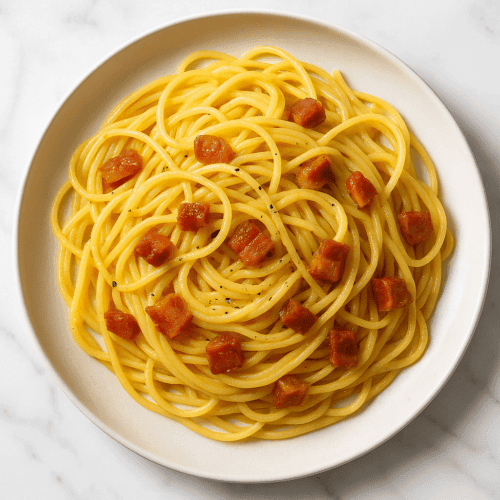
Easy Carbonara Without Cream
Ingredients
- 12 oz spaghetti or other long pasta
- 4 oz pancetta diced
- 2 tbsp olive oil
- 3 large eggs room temperature
- 1 cup Pecorino Romano cheese finely grated
- 1 clove garlic minced
- to taste salt
- to taste black pepper freshly cracked
Instructions
- Cook spaghetti in a large pot of salted boiling water until al dente. Reserve 1 cup of pasta water, then drain.
- In a skillet, heat olive oil over medium heat. Add pancetta and cook until crisp and golden, about 5 minutes. Remove from heat.
- In a bowl, whisk eggs with Pecorino Romano and a generous amount of black pepper until smooth.
- Add minced garlic to the pancetta in the skillet, allowing the residual heat to soften it without browning.
- Return the drained pasta to the pot. Off the heat, pour the egg mixture over the pasta, stirring vigorously to coat evenly.
- Gradually add reserved pasta water, a few tablespoons at a time, until the sauce reaches a creamy consistency.
- Toss in the crispy pancetta and garlic, ensuring even distribution throughout the pasta.
- Serve immediately, garnished with extra cheese and black pepper if desired.
Pro Tips
- Use room temperature eggs to prevent them from scrambling when added to the hot pasta.
- Reserve pasta water to adjust the sauce’s consistency, making it easier to achieve the perfect texture.
- Cook pancetta until crisp, allowing the rendered fat to infuse the pasta with flavor.
- Add cheese gradually to prevent clumping, ensuring a smooth, even sauce.
- Stir continuously when combining pasta with the egg mixture to create a creamy texture.
Variations
- Budget: Substitute pancetta with diced bacon for a cost-effective option.
- Dietary: Use gluten-free pasta to accommodate gluten sensitivities without altering the sauce.
- Seasonal/Swap: Incorporate fresh peas for a spring twist, adding sweetness and color.
- Cuisine: Add a pinch of chili flakes for an Italian-American fusion with a hint of spice.
Storage
Store leftover carbonara in an airtight container in the refrigerator for up to 3 days. Freezing is not recommended due to the egg-based sauce, which can become grainy when thawed. Always reheat gently to prevent the eggs from scrambling, maintaining the sauce’s creamy texture.
How to Reheat
Reheat carbonara gently on the stovetop over low heat, adding a splash of reserved pasta water to loosen the sauce. Alternatively, use a microwave at 50% power in 30-second intervals, stirring frequently to avoid overheating the eggs.
Recommended Equipment
- 8-Inch Chef’s Knife — The prep tool this recipe leans on most.
How to Make Carbonara Creamy Without Cream
The creaminess in carbonara comes from an emulsion, not from dairy cream. Egg yolk, grated Pecorino and the starchy water the pasta cooked in are whisked into the rendered pork fat until they thicken into a sauce. Get the temperature right and the result is glossier than any cream version; get it wrong and you have scrambled egg on spaghetti. The whole recipe turns on that one step.
Start with the ratio. For two servings, use one whole egg plus one extra yolk for every 100 g of dry pasta, with about 40 g of finely grated Pecorino Romano. Grate the cheese finely rather than coarsely: fine shreds dissolve, coarse ones clump. Beat the egg, the cheese and a generous amount of coarsely ground black pepper into a thick paste before the pasta is anywhere near ready.
Render the pork slowly. Put the guanciale or pancetta into a cold, dry pan over medium-low heat so the fat melts out before the meat browns. You want the fat liquid and the pieces crisp at the edges, which takes seven to ten minutes. That rendered fat is the base of the sauce, so do not pour it away.
Then kill the heat. This is the step most recipes skip. Take the pan off the burner entirely before anything egg-based goes near it. Drain the pasta, keeping a mugful of the cooking water, and drop the pasta into the warm pan. Loosen the egg paste with a ladle of that hot water first, stirring as you pour so the egg warms gradually rather than hitting a wall of heat, then add it to the pan and toss hard and continuously.
Why eggs scramble. Egg proteins coagulate into visible curds somewhere above 70 °C (158 °F). A pan still on the flame is far hotter than that; a pan off the heat with hot pasta in it sits at roughly 65 to 70 °C, which is exactly where the yolk thickens and stops. If the sauce does tighten or look grainy, take the pan further off the heat, add a tablespoon of pasta water and toss vigorously. Never put it back over a live flame to fix it.
Adjust at the end. The sauce should slide off a lifted strand in a sheet, not sit in a puddle. Too thick, add water a tablespoon at a time. Too loose, keep tossing: it thickens as it cools. Serve immediately, straight from the pan, with more Pecorino and pepper. Carbonara does not wait, and it is the one part of the dish that cream was invented to forgive.
Why Authentic Carbonara Has No Cream
The Roman version of the dish is built on four ingredients: guanciale, Pecorino Romano, egg and black pepper. Pasta and its cooking water make up the rest. There is no cream in it, and no onion, garlic or butter either.
Cream entered carbonara through restaurant and packaged adaptations outside Italy, where it works as insurance: a cream-based sauce cannot split, so it survives a busy kitchen and a long wait on a pass. The trade-off is that cream flattens the sharpness of the Pecorino and the cured-pork flavour that make the dish what it is.
Leaving it out costs nothing but attention to heat. Once the off-the-burner method above is familiar, the cream version tends to taste heavy by comparison — which is why the shorter ingredient list is also the better one.
FAQ
How do you prevent the eggs from scrambling in carbonara?
To prevent scrambling, combine the egg mixture with hot pasta off the heat. Stir continuously to create a creamy emulsion. The residual heat from the pasta will cook the eggs gently without turning them into scrambled eggs.
What type of cheese is best for carbonara?
Pecorino Romano is traditional in carbonara, offering a sharp, tangy flavor that complements the pancetta. Parmesan can be used as an alternative, providing a milder taste. Ensure the cheese is finely grated for easy melting.
Can I make carbonara without pancetta?
Yes, you can substitute pancetta with other cured meats like guanciale or bacon. Each will impart a slightly different flavor profile, but the essential technique remains the same, focusing on the creamy egg and cheese sauce.
Is it necessary to use fresh pasta for carbonara?
While fresh pasta can enhance the dish with its tender texture, dried pasta is perfectly suitable for carbonara. It holds up well to the sauce and is more convenient for quick preparation, making it a popular choice.
Why is my carbonara sauce clumpy?
Clumpiness can occur if the cheese is added too quickly or if the sauce is overheated. To fix this, gradually incorporate cheese off the heat and stir vigorously, using reserved pasta water to adjust the sauce’s consistency.
Mastering carbonara without cream hinges on technique. By leveraging the heat of freshly cooked pasta and stirring continuously, you achieve a glossy, creamy sauce that highlights the simplicity and richness of Italian cuisine.